What Is CPM (Cost Per Mille)?
CPM stands for cost per mille, the price an advertiser pays for one thousand ad impressions. As a fixed pricing model, CPM is agreed before or during a campaign, giving advertisers predictable budgeting regardless of how well the ad ultimately performs. The formula divides total campaign cost by total ad impressions, then multiplies by 1,000.
Several factors move that number. Audience targeting narrows or widens available inventory, and tighter targeting generally raises price. Ad format and placement matter too: video and rewarded formats tend to command a higher CPM than standard banners. Seasonal demand also shifts pricing, since advertiser competition for impressions rises during peak buying periods such as Q4. Because CPM is fixed at purchase, it tells an advertiser what impressions cost, not what the resulting placement actually earned for the publisher running it.
What Is eCPM (Effective Cost Per Mille)?
eCPM, or effective cost per mille, is a normalized revenue metric that expresses total ad revenue per 1,000 impressions, regardless of which pricing model actually generated that revenue. Publishers use eCPM to compare income across CPM, cost-per-click (CPC), and cost-per-action (CPA) campaigns on a single, consistent scale, since raw revenue figures from different models are not directly comparable.
That $1,200 in revenue from 400,000 impressions works out to an eCPM of $3.00, whether it came from a handful of high-value CPC clicks or a larger volume of lower CPM impressions. Because eCPM is calculated after impressions are served and revenue is confirmed, it functions as a performance metric rather than a cost metric, and it is the standard yardstick publishers use to rank placements, formats, and demand sources against each other.
eCPM vs CPM: The Core Difference
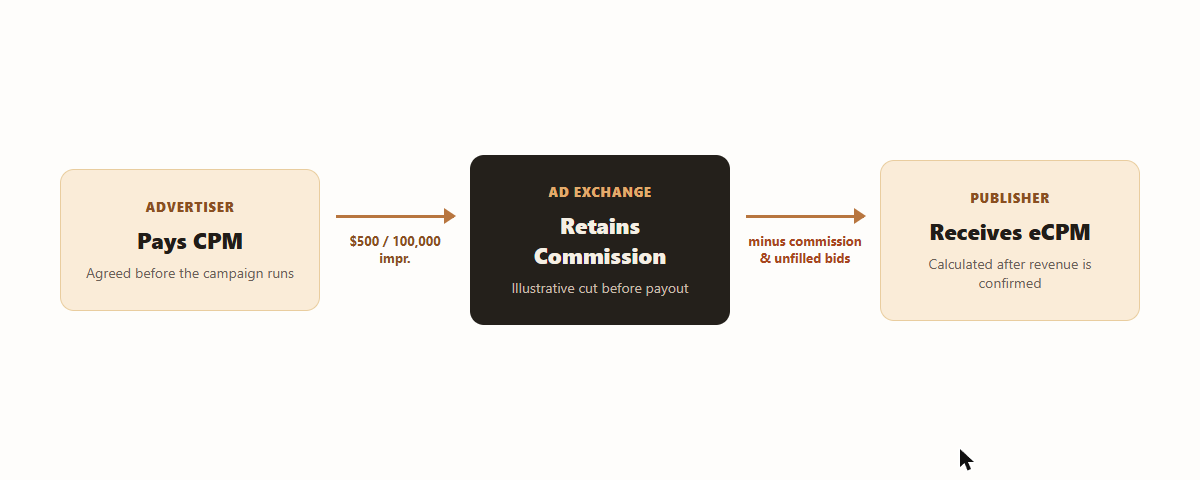
The distinction between eCPM vs CPM comes down to timing, intent, and who each metric serves. CPM is a forward-looking cost metric: an advertiser and ad exchange agree on it before or during a campaign, and it does not change based on how the ad performs afterward. eCPM is a backward-looking revenue metric: it can only be calculated once impressions have been served and revenue has been recorded, making it the publisher's measure of actual yield.
A common misconception is that CPM and eCPM should always match. In practice, the two figures for the same inventory often diverge because ad exchanges and mediation platforms retain a commission before passing revenue to the publisher. Advertisers use CPM to control spend; publishers use eCPM to evaluate what inventory is actually worth across demand sources, which is why the same ad placement can show a different number depending on which side of the transaction is looking at it.
Side-by-Side Comparison Table
The table below summarizes the practical differences between eCPM vs CPM across six dimensions, from who primarily uses each metric to when it becomes known during a campaign. Reviewing both side by side clarifies why the two figures rarely match exactly, even for the same ad inventory.
| Dimension | CPM | eCPM |
|---|---|---|
| Full name | Cost Per Mille | Effective Cost Per Mille |
| Primary user | Advertiser | Publisher |
| What it measures | Cost per 1,000 ad impressions bought | Revenue earned per 1,000 impressions served |
| When known | Set before or during a campaign | Calculated after impressions and revenue are known |
| Type of metric | Input / cost metric | Output / performance metric |
| Primary use case | Budgeting and bidding | Yield comparison across demand sources |
Worked Examples
Two short calculations show how the formulas apply in practice. A campaign that spends $500 to buy 100,000 impressions produces a CPM of $5.00, calculated as ($500 ÷ 100,000) × 1,000. A publisher that earns $1,200 in total ad revenue from 400,000 served impressions has an eCPM of $3.00, calculated as ($1,200 ÷ 400,000) × 1,000.
- Gross ad revenue: $1,200 from 400,000 impressions
- Ad exchange commission (illustrative, 9%): -$108
- Net publisher revenue: $1,092
- Net eCPM: ($1,092 ÷ 400,000) × 1,000 ≈ $2.73
The 9% commission rate above is illustrative only, not a documented industry standard; actual rates vary by exchange and contract.
The gap between what an advertiser pays and what a publisher nets often traces back to intermediary commissions like the one illustrated above, plus fill rate gaps when not every auction results in a filled impression.
When to Use Each: Advertiser vs. Publisher
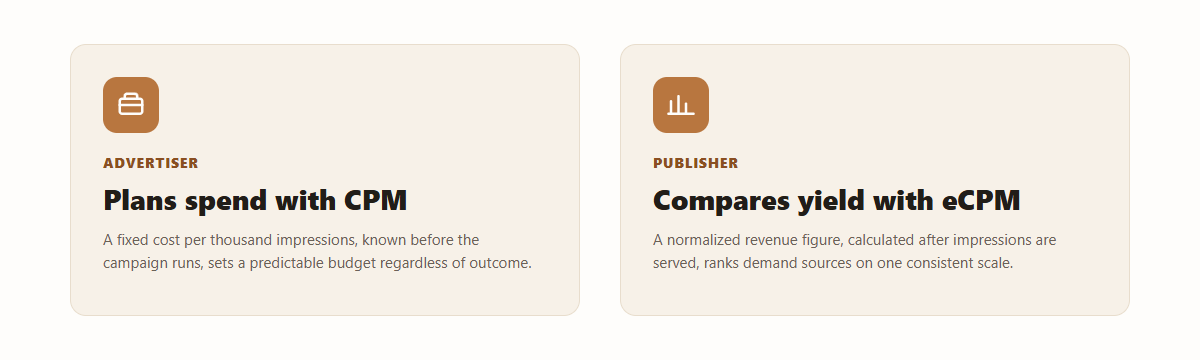
Advertisers rely on CPM because it is known in advance and lets a budget be planned around a fixed cost per thousand impressions, regardless of how the campaign eventually performs on click-through or conversion. This makes CPM the natural unit for upper-funnel awareness campaigns, where impression volume rather than direct response is the goal.
Publishers rely on eCPM for the opposite reason: it normalizes revenue across every pricing model and demand source running against their inventory, which is what makes yield optimization possible. A publisher comparing a CPM-based direct deal against CPC-based programmatic demand cannot compare the two raw figures directly, but converting both to eCPM puts them on the same scale. That comparison determines which demand source should receive priority in an ad request, and it is the foundation of any yield optimization strategy across multiple networks.
Increasing eCPM Through Multi-Mediation
Running a single demand source caps eCPM at whatever that one buyer is willing to pay for a given impression. Multi-mediation setups introduce header bidding, where several demand sources bid on the same impression concurrently, so the highest bidder wins rather than a single network taking inventory by default. This competitive dynamic is a core mechanism behind most yield optimization strategies.
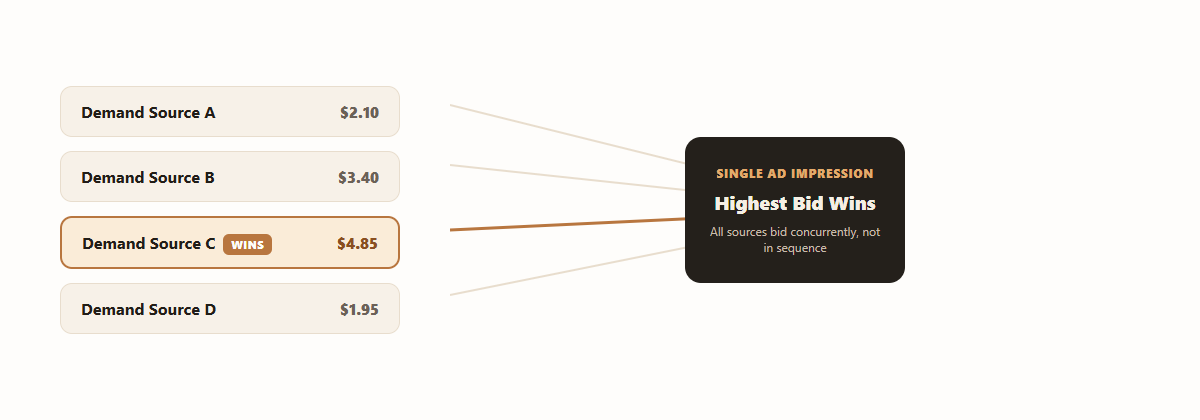
Mediation stacks commonly combine several demand sources side by side, such as AppLovin MAX, PubMatic, and Yandex Ads Monetization, each operating as a mediation platform among several demand sources competing for the same inventory. Adding demand alongside existing partners typically lifts blended eCPM, since more bidders competing for an impression tends to raise the clearing price, though the size of that lift varies by app, geography, and inventory type.
What Is a Good eCPM? Benchmarks
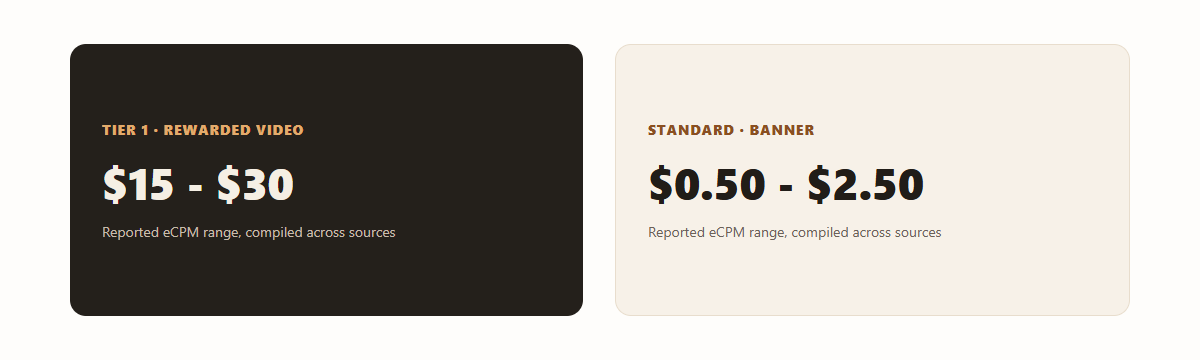
There is no single number that qualifies as a good eCPM, since the figure depends heavily on geography, ad format, and season. Reported ranges illustrate the spread rather than a target: Tier 1 rewarded video placements have reported eCPM roughly between $15 and $30, while standard banner placements have reported eCPM closer to $0.50 to $2.50, based on ranges compiled across several industry sources. Seasonal demand adds further variance, with Q4 commonly associated with an eCPM lift of roughly 20 to 60 percent compared with other quarters, again as a range rather than a fixed figure. Any benchmark should be treated as directional context, not a threshold to hit.
Conclusion
eCPM and CPM measure the same advertising transaction from opposite ends: CPM is what an advertiser agrees to pay before a campaign runs, and eCPM is what a publisher actually earns once impressions and revenue are confirmed. Understanding both, and why they diverge once exchange commissions and fill rate are factored in, is what allows advertisers to budget accurately and publishers to compare demand sources on equal footing rather than by raw pricing model alone.
Frequently Asked Questions
What is the main difference between eCPM and CPM?
CPM is a cost metric an advertiser agrees to before or during a campaign, fixed regardless of performance. eCPM is a revenue metric calculated after impressions are served, normalizing earnings across CPM, CPC, and CPA models so publishers can compare demand sources on one scale.
Why don't CPM and eCPM always match for the same impression?
Ad exchanges and mediation platforms typically retain a commission before passing revenue to the publisher, and not every auction fills. Both factors mean the advertiser's CPM bid and the publisher's realized eCPM can diverge even for the exact same ad inventory.
Is there a fixed number that counts as a good eCPM?
No. eCPM benchmarks vary by ad format, geography, and season, so published ranges should be treated as directional context rather than a fixed target. Reported ranges for rewarded video and banner formats, for example, differ by a wide margin.
How does multi-mediation affect eCPM?
Multi-mediation setups use header bidding to let several demand sources, potentially including regional platforms such as Yandex Ads Monetization, bid on the same impression at once. More bidders competing for an impression tends to raise the clearing price, which is a primary lever for yield optimization.
Does eCPM apply only to CPM-based campaigns?
No. eCPM normalizes revenue from CPC and CPA campaigns onto the same per-thousand-impression basis as CPM, which is why publishers use it as a single comparison metric across every demand source and pricing model running on their inventory.